 seolounge




Google is changing how people discover products through AI-powered search. Instead of sending every shopper directly to an online store, its AI Mode often displays product information and links through Google Shopping. This creates new opportunities for product visibility but also raises questions about how much traffic retailers will receive from AI search.
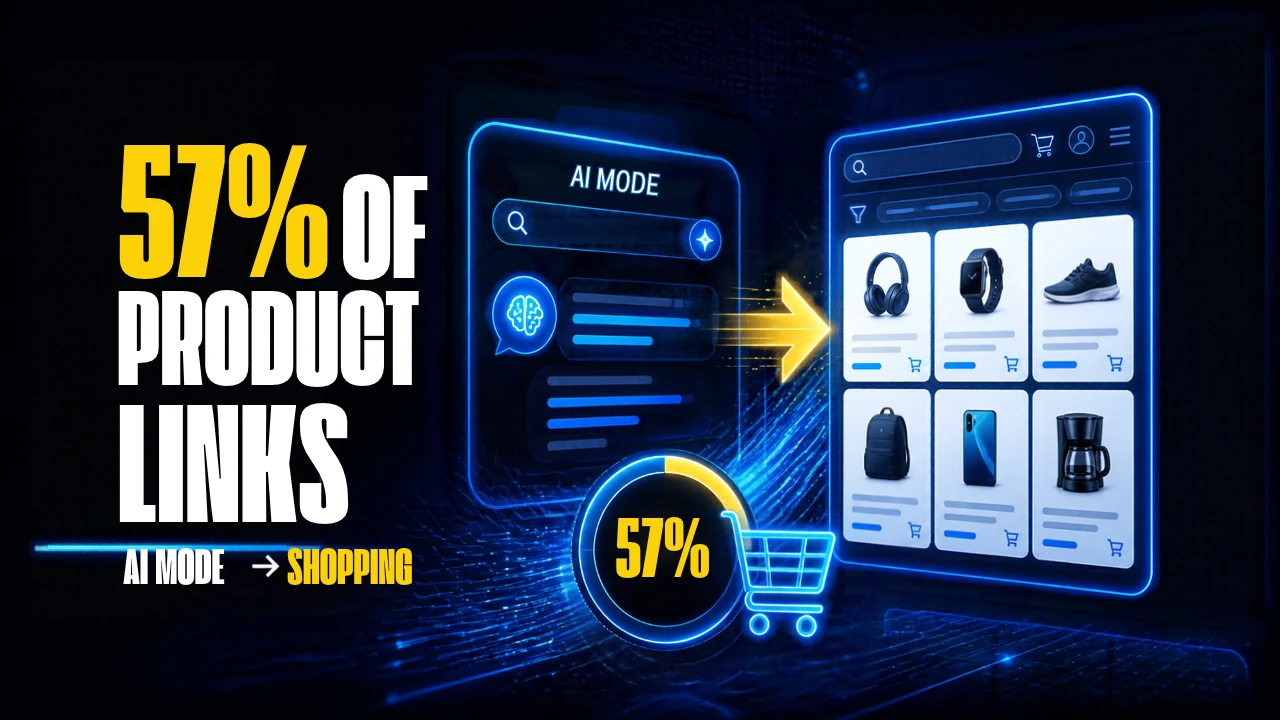
A recent study by Findrix found that 57% of product links shown in Google AI Mode led to Google Shopping product pages. The research also found that 46.5% of US product answers linked only to Google’s own pages. These findings suggest that shoppers may discover products through AI search without immediately visiting a retailer’s website. Search Engine Land+1
For ecommerce businesses, this means that product visibility is becoming about more than traditional organic rankings. Accurate product information, shopping feeds, reviews, and brand presence across different platforms are becoming increasingly important.
What Does the Study Reveal About Google AI Mode?
The research was conducted by Findrix, an AI visibility measurement platform. It analyzed 18,400 buyer questions across 35 US markets between October 14 and 17, 2026. The questions were tested on Google AI Mode, ChatGPT, and Gemini, producing 55,198 AI-generated answers.
Some important findings include:
- 57% of product links in Google AI Mode product answers led to Google Shopping pages.
- 46.5% of US product answers linked only to Google’s own pages.
- Fashion and beauty products had a high share of Google-only links.
- Only 5.1% of links for local services and 1.1% for software questions went to Google pages.
- ChatGPT provided around 25 links per answer, compared with approximately three links in Google AI Mode.
The study measured links displayed in AI answers, not actual clicks, sales, or purchases. Therefore, these figures show how AI search presents product information rather than how shoppers behave after seeing it.
Why Does Google AI Mode Send Product Links to Google Shopping?
Google Shopping already contains product information collected from merchants and other sources. This information can include product names, prices, images, ratings, and availability.
When someone searches for a product, AI Mode can use this information to create a shopping-focused response. Instead of requiring users to visit several websites to compare products, it can display relevant options within Google’s search experience.
For example, someone searching for the best running shoes may see product recommendations with images, prices, and shopping links.
This makes product discovery easier, but it also means that retailers may receive fewer direct visits from some AI-powered product searches.
Which Product Categories Are Most Affected?
The study found that Google AI Mode linked only to Google’s own pages more frequently for certain fashion and beauty searches.
Some category findings included:
- Swimwear: 60.4% of answers linked only to Google pages.
- Women’s everyday fashion: 57%.
- Sun care: 54.1%.
- Activewear: 53.8%.
- Sports nutrition: 7.6%.
These differences suggest that AI Mode does not handle every product category in the same way.
Google’s product database may be particularly useful for categories where shoppers compare prices, product details, ratings, and availability. However, the study does not establish exactly why each category received different results.
For ecommerce businesses, checking how their products appear in AI search is becoming an important part of understanding online visibility.
How Does Google AI Mode Compare With ChatGPT and Gemini?
AI search platforms do not always provide information in the same way.
Google AI Mode uses Google’s shopping information to display product recommendations. ChatGPT and Gemini may rely on different sources and provide different types of links.
In the Findrix study, ChatGPT included around 25 links per answer, while Google AI Mode included approximately three. For product answers, ChatGPT linked to Walmart in 45.1% of measured cases and Amazon in 6.1%.
The research also found differences in Reddit citations. ChatGPT cited Reddit in 35.6% of all US answers, compared with 5.1% for Google AI Mode and 1.5% for Gemini.
This shows why businesses should not depend on a single AI platform when planning their AI search optimization strategy.
What Does This Mean for Ecommerce Businesses?
The growing role of Google Shopping in AI Mode creates several important considerations for online retailers.
1. Keep Google Merchant Center Data Accurate
Product information plays an important role in shopping visibility. Retailers should make sure their Google Merchant Center feeds contain accurate product names, descriptions, prices, images, and availability.
Incorrect or outdated information can create confusion and affect the shopping experience.
2. Improve Product Page Quality
Your ecommerce website still matters. Each product page should provide useful information that helps customers make purchasing decisions.
Include clear product descriptions, specifications, benefits, high-quality images, shipping information, and return policies.
Avoid using the same generic description across multiple products. Unique and accurate details help customers understand what makes each product different.
3. Use Product Schema Markup
Structured data helps search engines understand important product information.
Ecommerce websites can use Product schema markup to describe product names, prices, availability, reviews, and other supported details.
Make sure the structured data matches the information visible on the actual product page. Schema markup can help search engines interpret product information, but it does not guarantee AI recommendations or rich search results.
4. Build Trust Through Reviews
Customer reviews can help shoppers compare products and understand their quality.
Encourage genuine customer feedback and respond to questions professionally. Display relevant product ratings and reviews where appropriate.
Strong customer experiences can support brand trust across search engines, shopping platforms, and other online channels.
5. Monitor AI Search Visibility
Traditional SEO reports mainly focus on website clicks, impressions, rankings, and conversions. However, AI-powered search can display product information without generating a direct website visit.
Businesses should also monitor whether their products appear in AI answers, which sources are referenced, and how their visibility changes across different platforms.
These checks should complement existing SEO reporting rather than replace conversion and sales tracking.
How Should Businesses Prepare for AI-Powered Shopping?
Businesses should continue investing in traditional SEO while improving their product data and shopping experience.
Start by reviewing your Merchant Center account, checking product feed accuracy, and improving important product pages. Then review how your products appear in Google AI Mode and other AI search platforms.
It is also useful to monitor competitors, compare product information, and identify gaps in your online presence.
Remember that appearing in an AI-generated product answer does not automatically mean a customer will make a purchase. Product quality, pricing, reviews, delivery options, and customer service still influence buying decisions.
Prepare Your Ecommerce Strategy for the Future of AI Search
The growing connection between Google AI Mode and Google Shopping shows that online product discovery is changing. Shoppers can now explore products through AI-generated recommendations without immediately visiting multiple ecommerce websites.
For retailers, this creates a need to focus on both website performance and product visibility across shopping platforms.
Accurate product feeds, helpful product pages, structured data, genuine reviews, and a strong brand presence can support a more complete ecommerce SEO strategy.
Businesses that adapt to these changes while keeping customer needs at the center of their approach can build better visibility and create a smoother online shopping experience.
